Monday, October 18, 2010

2010-11-03 Holland Ponds - 2010 October and September Observations

2010-11-03 Holland Ponds - Multiple Trips

Holland Ponds is in Macomb County off Ryan Rd. just north of 22 Mile Rd.

Several trips! Hamlin Road construction is finally finished and we now go more directly and more often to our favorite near-by spot again. I think it is important to frequently visit the same place (if possible) to record seasonal variations in the avifauna. Besides that, it is much cheaper on gas, and something to do on the spur of the moment. And, of course, our motto ("You never know ...") always drives us forth.

This blog is still "in process" like road construction, so please come back! I have all of the records from eBird here, but I intend to add more pics as soon as we stop "going" and start "doing".

During the time period in September and October, we watched the Holland Ponds trees turn pretty colors and then lose their leaves. We have one tree in particular that Judy photographs each time to show the progression. Fall fell, and the tree is now barren.

This is the first year we learned that many knowledgeable people park at Holland Ponds to take a hike to Yates Cider Mill as a fall adventure. Yates is located at Dequindre and Avon / 23 Mile Rd. and is normally a "zoo" for parking and traffic. If you go out the back end of Holland Ponds to the right, you soon will find a trail that goes down some stairs to a path along the Clinton River  and a good trail that takes you to Yates Cider Mill. You can grab some cider and donuts to fortify yourself for the return walk. We often recently saw folks walking at Holland Ponds with a partially empty half-gallon of cider. We also saw a really buff guy carrying a full gallon in one hand and a half-gallon in the other followed distantly by his whining ("I'm tired") companion. Ah, yes; the toll of the return trip must be considered! We also saw fairly young and still energetic (donuts are rather energizing I think) kids with their parents, so it is quite "doable" for a family. It is more barren now, but still a nice hike.

Cool birds - new records! This was a wonderful thing to do more consistently than ever before. I have to remember to try it more frequently in the spring if I can just get the "sirens" (think Greek mythology and sailors) of new bird postings elsewhere calling me away.

Notes:
1) All of the listings below were taken from eBird emails sent to me because I checked the request e-mail  box when I submitted the data. I am a firm believer in eBird (Cornell University). I have the opportunity to add to the global birding database. It also makes it so easy to share my listings.
2) I am still a very inexperienced birder and only record those birds for which I am positive of IDs. I have pics to process that will add to the lists below. And, that is OK with eBird as well. Cornell allows me to update my eBird lists later as I process photos and discover additions or changes.
3) I am not sure of the real percentage, but I guess I miss maybe 10 to 20% of the birds I actually see. (Hey! That was something different.) I am also positive I miss maybe another 30 - 40% of the birds I only hear.(Hey! That was something different.) Anyway, I am learning. Yet I know really good records are out there for an experienced birder to add to Holland Ponds.
4) It was wonderfully special for me this year to propose Holland Ponds as an eBird "Hot Spot" and have it accepted! I know there are many birders who have personal eBird checklists from Holland Ponds, and I encourage you to please merge them into the newly recognized Hot Spot. In today's economy, all municipal expenses are being scrutinized, and I fear that Shadbush Nature Center (that oversees Holland Ponds) may face a fate like Lloyd Stage Nature Center in Troy (even the Troy Public Library for that matter) and be closed.
Economic times are hard. On the other hand, it was wonderful to be involved with a recent birding issue about Robert Long Nature Park in Commerce Twp. and see the impact of a consolidated eBird list and active support of the birding community. I truly know we make a difference when we get out acts together! Please help Shadbush Nature Center and me have access to similar info (just in case) by merging your lists to show the strongest possible number of birds that are residents or visitors at Holland Ponds.

The following lists are from eBird with additional notes and species comments added here.

Observation date: 10/29/10
Notes: First MINK we have seen there (two views - unfortunately no pics - fast little guy!). Also a sunning snapping turtle and an Inky-cap mushroom that had obviously erected to full height just today. Nice day - 50 degrees, sunny, medium winds. Generally it was a slow day, but the mink sighting and Kinglet activity alone were well worth the visit. Wow! "You never know..."
Number of species: 12

Canada Goose 8
Wood Duck 1 - Napping
Mallard 30
Downy Woodpecker 4
Blue Jay 1
American Crow 1
Black-capped Chickadee 6
Ruby-crowned Kinglet 2 - Unafraid! Best pics ever!!! These two guys allowed me to get quite close.
Song Sparrow 4
White-crowned Sparrow 4
Northern Cardinal 1
Red-winged Blackbird 1

Ruby-crowned Kinglet with bizarre fly

Ruby-crowned Kinglet in a rarely observed milli-second pose of imagined glee


Observation date: 10/27/10
Notes: 63 degrees. Extremely windy!
Number of species: 10
Canada Goose 10
Mallard 40
Pied-billed Grebe 1 (I think really cool for Holland Ponds!!)
Ring-billed Gull 1
Belted Kingfisher 1
Red-bellied Woodpecker 1
Downy Woodpecker 1
Blue Jay 1
Black-capped Chickadee 1
American Robin 6


Observation date: 10/19/10
Notes: 47 degrees to 52 degrees. Sunny and cool!
Number of species: 11

Canada Goose 15
Wood Duck 3
Mallard 36
Mourning Dove 1
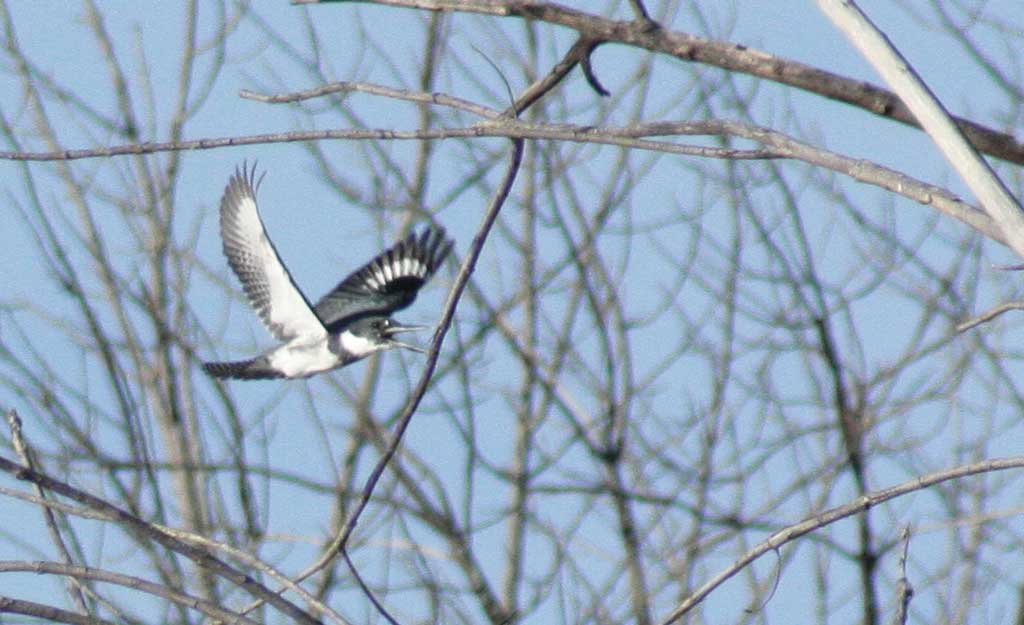
Belted Kingfisher 2 - One male perched, then chasing another kingfisher for quite awhile. I lucked into a fantastic shot of a Kingfisher flying!
Black-capped Chickadee 4
Ruby-crowned Kinglet 6 - First for us in Michigan! Busy in bushes.
White-throated Sparrow 2 - First for us in Michigan! At "first fishing access" on left near entrance.  (see photo)
Northern Cardinal 1
Red-winged Blackbird 20
Common Grackle 15


Belted Kingfisher in flight
(I am still working to improve the photographic quality of this ... Jerry Jourdan showed me what is possible - thanks so much Jerry! - and I am getting closer, but I've not completed my "lesson plan" yet ...)

Observation date: 10/17/10
Notes: 64 degrees
Number of species: 16

Canada Goose 4
Wood Duck 3
Mallard 36
Great Blue Heron 1
Mourning Dove 1
Belted Kingfisher 1
Red-bellied Woodpecker 1
Blue Jay 1
American Crow 1
Black-capped Chickadee 4
American Robin 2
Cedar Waxwing 1
Yellow-rumped Warbler (Myrtle) 6
Red-winged Blackbird 17
Common Grackle 10
American Goldfinch 2


Observation date: 10/14/10
Notes: Had rained yesterday. Today was 60 degrees and sunny. Also saw three butterflies (white; yellow; and Buckeye) and several dragonflies.
Number of species: 6

The most exciting thing was seeing the streaked breasts of the Waxwings. Different looking! Also great to still see the Common Buckeye butterflies still around! Otherwise not too much excitement.

Canada Goose 4
Wood Duck 1
Mallard 40
Black-capped Chickadee 1
Cedar Waxwing 20 Many young ones with streaked breasts!
Common Grackle 1


Observation date: 10/12/10
Notes: 54-62 degrees. Saw several painted turtles.
Number of species: 19

Canada Goose 10
Wood Duck 3 - Heard a really weird noise. I kept looking around, and Judy told me it was the duck. It was the female WD. Standing on a log, lowering its head snakelike while making the noise. It was the first time we ever heard this sound. I gotta tell you, "it don't quack like a duck"!
Mallard 39
Great Blue Heron 1
Great Egret 1
Belted Kingfisher 1 - Heard only.
Downy Woodpecker 1
Blue Jay 1
American Crow 1
Black-capped Chickadee 6
Eastern Bluebird 1
American Robin 1
Cedar Waxwing X
Yellow-rumped Warbler 1
Chipping Sparrow 1
Dark-eyed Junco 4  - First here for us!
sparrow sp. X (Working on pics ...)
Northern Cardinal 6
Red-winged Blackbird 25
Common Grackle 15

Observation date: 10/9/10
Notes: 70 degrees; sunny. Painted turtle, yellow butterfly, white butterfly. Two species of dragonflies.
The most amazing thing today was that I "pished up" a chickadee I heard and it drew closer. It perched on nearby branches. Feeling in my pockets, I found a half-dozen seeds from a prior trip to Kensington MP, and while pishing, extended my hand with the few seeds. The chickadee came within three inches of my outstretched hand several times. It never quite made a landing - I only had a few token seeds. It was certainly a remarkable occurrence. Other than at Kensington, this is the only time where this has ever happened to me! I just gotta wonder if it was a displaced "Kensington chick" that had learned the behavior.
Number of species: 13

Canada Goose 6
Wood Duck 1
Mallard 20
Pied-billed Grebe 1 - First one we have seen here!
Downy Woodpecker 1
Blue Jay 1
Black-capped Chickadee 1
American Robin 1
Cedar Waxwing 3
Yellow-rumped Warbler 1
White-crowned Sparrow 4
Red-winged Blackbird 11
American Goldfinch 1

Observation date: 10/6/10
Notes: 72 degrees
Number of species: 12

Mallard X
Mourning Dove 3
Northern Flicker 1
Blue Jay 3
American Crow 2
Black-capped Chickadee 5
Cedar Waxwing 30
Yellow-rumped Warbler 4
Northern Cardinal 2
Red-winged Blackbird 1
Common Grackle 4
American Goldfinch 1

Observation date: 9/30/10

Notes: 72-73 degrees; sun/clouds. Also butterflies: yellow, white, Buckeye. Painted Turtles.
Number of species: 14

Canada Goose 6
Wood Duck 2
Mallard 10
Great Blue Heron 1
Great Egret 1
Red-bellied Woodpecker 1 Heard only
Downy Woodpecker 2
Northern Flicker 1
Blue Jay 4
Black-capped Chickadee 1
American Robin 1
Yellow-rumped Warbler (Myrtle) 6 West of shelter
American Goldfinch 2
House Sparrow 1


Observation date: 9/24/10

Notes: 80-83 degrees; very windy!
Number of species: 9

Canada Goose 1
Wood Duck 2
Mallard 19
Great Blue Heron 1
Mourning Dove 2
Blue Jay 20
American Robin X
Red-winged Blackbird X
American Goldfinch 8

Observation date: 9/21/10

Notes: 72 - 78 degrees. Sunny.
Number of species: 14

Canada Goose 2
Wood Duck 1
Mallard 12
Great Egret 1
hawk sp. 2
Ring-billed Gull 1
Mourning Dove 2
Northern Flicker 1
Eastern Phoebe 1
Blue Jay 1
Black-capped Chickadee 1
Gray Catbird 1 Heard only
Cedar Waxwing 2
Yellow-rumped Warbler (Myrtle) 8 Eating poison ivy berries!
House Finch 1


Observation date: 9/12/10
Notes: Weird day! Lots of juveniles who look quite unlike bird book pics!

Also saw snake, grass frog, buckeye butterfly (and another good b'fly).
Number of species: 7

Mallard 11
hawk sp. 1 - From a very quick view as it flew away, it looked mostly white like a seagull. Maybe an osprey? Certainly not a gull.
Belted Kingfisher 1 - Came out of forest over our heads. Rattling. Great views!
Downy Woodpecker 1
Blue Jay 1 Heard only.
Black-capped Chickadee 1 - Heard only.
Cedar Waxwing 12 - Lots of juveniles. Mostly gray with streaked breasts. Acting like swallows eating bugs over lake (but higher than swallows do ...). Quite different!
Northern Cardinal 5

2010-10-07 Hawkwatch at LEMP and Sterling TVs

2010-10-07

Dropping my notes to Mich Birders as a placeholder to get this into the right blog month and sequence -  I'll finish later....


I  just gotta write a blog about today, but do not hold your breath! I think y’all sense how far behind I am! It will come after sufficient gestation. It is just too much fun “doing” right now!


On the other hand, I just want to share a few pics I got this afternoon.

Judy and I went to the hawk watch at LEMP and met some really great birders! We learned a lot! Thanks to all!!!

Mostly the birds were not too exciting. One kettle of Turkey Vultures passed over, but I would have never even seen them except for loaned lenses and excellent directions. Even then, they were just “dots in the sky”. These watchers are truly amazing! “Look over the A-frame”, “look over the mustard house”, “look over the stacks” – say what? Where? Oh, come on!

Yet, after “tuning in”, yes there are birds there!

Anyway, we were still looking for our first more personal “kettle” of big birds when we left to check out new places for other birds in the area. After a few places and much walking around, we settled at Sterling State Park for lunch. As we exited the car, I saw a bunch of “dots” over the far hill, and had time to grab my camera. The birds proceeded to come closer and actually flew right over head! I just processed a few now to share. The overhead pics are on another card (why is it that every time something exciting happens, I need to change cards? It’s certainly not like they are 36 exposure rolls!!!)

Check out (do “next” to see all 3 pics):

http://www.pbase.com/doctorbass/image/129223775

And, that was it. We never saw another bird during lunch! As we say: “You never know”!

It made our “watch day”. We have seen a few TVs in the sky at one time before, but never going somewhere together!

2010-09-04 Point Mouillee

2010-09-04 Point Mouillee

Note 2 (2010-10-18):  I really got stuck on this blog. It was a really special day, and I wanted to put more of my pics here before I "published". Yet, it has now been over a month and I still have not worked up most of my pics. Judy and I tend to just keep "doing" while weather permits. The birds and birding opportunities keep changing with the seasons, and we keep discovering. I also have learned that an over abundance of photos (like from this day - over a thousand pics - which is the best?!) certainly clogs my propensity to publish. OK, Hey, what am I trying to do - publish a book? Well, maybe ... Being old school, I just gotta learn that a blog is designed to be more immediate.
Actually, I know my blog is whatever I want it to be. I want a collective "book" of my experiences for my own reference, but I also want to share with my birding friends and mentors in a reasonably quick time frame. I obviously failed on the latter and will hopefully improve, but the former (Dr. Bob's Bird Book - for Dr. Bob and friends by Dr. Bob ... or whatever) seems to offer hope as an option. Judy and I might be the main audience for the book, but I appreciate the eblog-forum for recording experiences.

Anyway, I am going to post this tonight so I can move on to more recent exploits!

Note 1 (2010-09-xx): this blog just may "go on forever", or at least thru this winter. I shot so many pics, it will take "forever" just to select the ones I want. So, come back later and see how it turns out.  Hey that's another neat thing about this blog space. You can amend it as your memory refreshes ... or as your memory embellishes? I certainly strive to keep it the former.

Background and Overview

Fantastic day! We had a chance to meet up with Cathy Carroll (a special person) in a special place (Pte. Mouillee) and saw many lifers - not only birds, but also "bugs" (mostly dragonfiles, but also butterflies).

Cathy is a true naturalist! She is not just a "bird watcher" out to get check marks on some list of birds, but she is really a "birder" (a more formal designation in the sense that she wants to understand the lives of the birds she sees as well as to see new birds). Cathy is also a naturalist.
I note that when I use the term naturalist, I am suggesting that from me it is a commendation of the highest order and refers to a person who desires to understand how all aspects of "life in nature" are related. In this case I linked  to a wiki ("naturalist") that requires far more work to be expressive of what it means, but it is a start. Case in point, I am referring to Cathy's abilty to enjoy and document and share the details every natural thing she sees. All life is wonderful and precious!

Cathy is fantastic! She already (and very quickly I might add!) blogged the trip on her exceptional blog "Into the Woods and Elsewhere". Our memorable day was documented!
Judy and I were very honored to be mentioned by name in Cathy's blog!

We had attempted reaching the place ("the promised land") twice before at Pte. Mouillee. Pte. Mouillee is a very difficult place to bird unless well prepared with maps and fortitude - ref my previous blog.  It was an easy walk out to "Cell 3" of the "Banana Unit". The wind was at our back. Expectations were high.
We started at the Roberts Road parking area. Roberts Rd. is by far the best access to the Banana Unit cells! I need to note it is a five mile hike to Cell 3 and back even from Roberts Rd.!  As we started along the access, our immediate thought was that there was little water visible along the shoreline of the lake itself. My first comment was "Wow, this has really dried up a lot since last week!"  We had seen lots of birds before, and now noticed mostly mudflats on the lake below our feet. Just last trip we had spoken with a fisherman on the pier at the bend (silly guy - it was shallow even then, but he was outdoors on a great day, so who's to complain? He once caught a 20 pound catfish there and was optimistic!). Yes, it had been hot, but not that hot ... Somewhere along the walk (about the time we turned left toward Cell 3), I realized that the prevailing winds had driven the water away from the shoreline. I figured the water must have all gone to Ohio! :) Whew! What a difference!

The walk out was pleasant (great cool temps and the wind at our back). We did not see the Moorhen and chicks we saw before. We encountered a few goose hunters returning. Only one had a goose (a party of three who had been there since 4 am). I had worn my blaze orange hat out, but realized that the goose hunters were all wearing camo, so figuring that goose hunters probably would not shoot camo on the dikes, before hitting the "promised land" in Cell 3, I changed to the camo hat I had in Judy's backpack. I was worried that the birds might "see" orange as a threat. (I do know white is a bad color for birders). On the other hand, I think the color-awareness thing is mostly for land birds, and not the shorebirds. Someday I might figure it out.

I also thought it was appropriate that just after the hunters passed us, seven geese flew directly over our heads. I dutifully "shot" them proclaiming my goose hunt a success.

As we walked toward Cell 3, we finally saw a few birders ahead of us. We also saw a few birds at the edge of the dike where we were, so paused to take pics. I shot several pics of a new bird. When we finally got to meet up with Cathy, her first question was "did you see the Red-necked Phalarope"? As usual, I had no clue. She walked us back along the dike to catch it. As it turned out, I already had a few dozen pics of the Phalarope. Yes, great bird!!!

Our First Shorebirds

insert pic - Phalarope pics

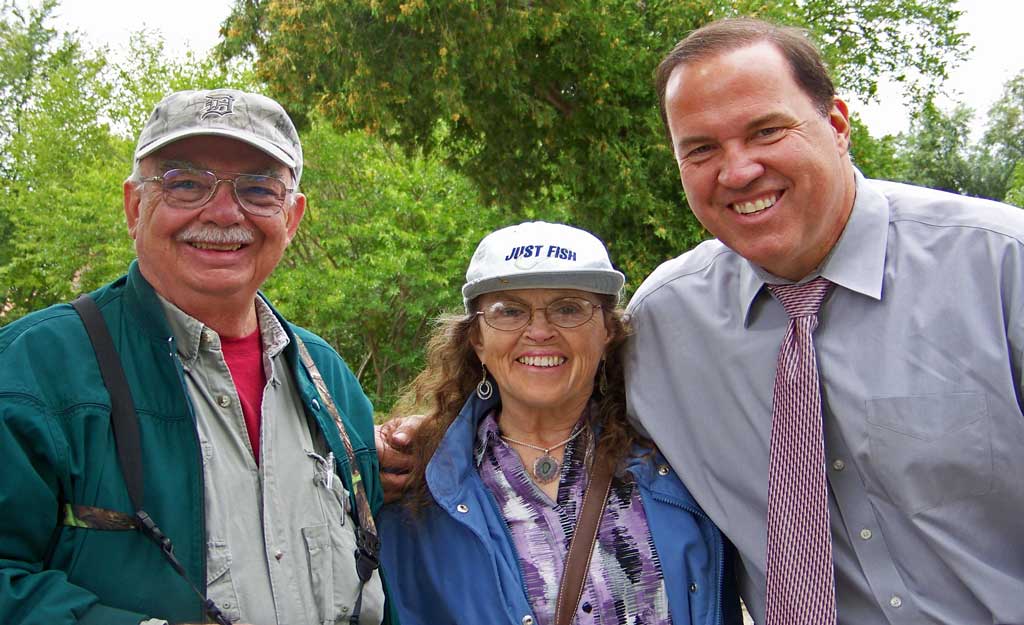
It was unusually windy (35-40 mph gusts)! Here's a pic of Cathy, Rudolpho (another visiting birder who Cathy had known before)  and myself. Cathy just barely caught her hat before it joined the birds on the mudflat below! After Judy's hat blew into the Phragmites enroute, Judy and I already had tightened our hats to "the next notch" on the way out to Cell 3. What wild winds!


After watching the birds on the NE corner of Cell 3 awhile (dozens of pics!) with Cathy and Rudolpho, we walked the tranverse dike towards the great expanse of Lake Erie. Rudolpho headed back. Cathy already had pointed out perhaps a dozen lifers for us. The lighting was poor - strongly backlit - and we were ready for more birds with better photo ops. Without counting, I would guess there had been several dozen shorebirds in the nearest corner of Cell 3. Yes! The "promised land"!

insert pic - Marbled Godwits

insert pics - others

Aside:
I found it interesting to see the previous footprints in the mudflat at this corner of Cell 3. It brought to mind a story told to us by a returning (really fantastic pro!) bird photographer we had met returning from Cell 3 on another occasion who recounted a story about almost being swallowed by the mudflats while waiting for one of the photos by which he is known. He normally sits and waits for a shot. Some mudflats do not accommodate sitting and waiting. Slowly, slowly you just sink. I could just picture that! Sitting - waiting. Sitting - sinking! Abandon ship!!! (I well remember clam-digging in San Francisco Bay as a youth. As long as there is a gravel base, you are fine, but go a couple feet beyond, and you will be quite lucky to even get your boots back from the sucking mud!). I "saw" the entire story of his time previous trip unfolding before my eyes as I looked at the footprints. I could not help but to smile - been there done that!

I also recalled a story told to me by another local birder who had tried to more closely approach the "Banana birds" a few years before and had returned to the dike belly-first  after almost being swallowed by the mud. Fascinating! No one here ever met the SF mudflats before. I was personally lucky to even get one boot back in SF.
Back to the story:
 
Enroute, Cathy asked another birder if he had seen the Buff-Breasted Sandpipers. No. (Coming attractions ...)

The Bug Chapter - with whirling Red-necked Phalaropes

We wound up behind some trees that offered a bit of protection from the wind. These were lots of Dragonflies. Since they are "flappy things", I just must shoot them! And, of course, now I must learn their names. Please help, Darrin and Julie. After I get more than a dozen or so pics of d'flies for my "life list", I'll have to get more proactive in my learning and use the great references you guys have sent me, but right now, I am just trying to get this belated blog into cyberspace!

There was also a Red-necked Phalarope whirling around on the shallow water surface. I learned that because they have some lobing between their toes - quite unlike most shorebirds, they are able to create an "upwelling" from the bottom mud they stir up, bringing food articles to the surface. What  trick! Now I just have to wonder, do the birds in the southern hemisphere use the reverse direction of spinning motion to bring up food? (I admit, I am thinking of bathroom drains which drain the tub in a different swirl relative to a clock face ...). I think I read somewhere that this is an individual behavior for each bird, but that brings up another question - are there left-twirling and right-twirling RN Phalaropes? Were they born with it, or was it taught?

insert pic - lobed foot
Insert whirling pic
Insert several d'flies
Insert b'flies


The Buff-Breasted Sandpipers Chapter

As we returned from our sheltered buggy Phalarope excursion, we found the Buff-breasted Sandpipers ("Buffies") right beside the dike path feeding amongst the land vegetation. I shot about 100 pics (well ... maybe more ...), with three exposures of each. Well, not really three of each - by the time the camera fired again, the bird was in a different pose - a new pic entirely! It amazes me. I am shooting at maybe 1/1000 of a second, and by the time the camera fires for subsequent shots the bird moves. I guess it is the recycle time to write the previous photo to the memory card.

Lesson learned: forget "bracketing exposures" with birds. Birds are always on the move. Usually the best exposure is not the best pose! OK, next time I might try just shooting "raw" instead. On the other hand, raw exposures take so much time to upload to the memory card, I really think I am better off just shooting a continous series and hope the exposure settings are good. (Sorry if I ramble about camera stuff, but as I have said before, this blog is at least as much for me as for you. And, any of y'all with DSLRs might just benefit from this side track.) It's just too much to handle! Yet I try.

There were initially five birds in the group we were observing. As we walked along, two more joined them.

Did you ever try to hold a non-image stabilized lens in a strong wind? Even at 1/1000 sec it is hard to get the right object on the focus spot! OK, I know - use a tripod; use an IS lens. I cannot afford the image-stabilized (IS) lenses and I did not want to carry the tripod that far. I do what I do. I shoot lots, hope to get some decent pics, and at least get many memories from my pics.

Cathy taught me another great lesson with the "Buffies". Actually there were at least two lessons.

1) Be "creepy" - that is, be inconspicous and inobtrusive. I learned this lesson again later when shooting the Palm Warblers on our walk back. I figured that they had been on the path eating bugs for quite awhile, so they probably would just continue to do, so I approached too closely. Off they flew! OK, lesson 1. Maybe I'll learn it again - probably many times...

2) Get down to a good level. Not only would I have been more stabilized - especially considering the windy conditions I am whining about regarding photographs, but also I would have gotten better "bird level" pics as did Cathy. OK, I get it - lie, crawl and shoot! Cathy was so kind to serve as an example rather than chiding me! Judy and I did recognize what she was doing, so we kept back and were still; at least we were that cognizant and respective of an expert sharing her technique. (The Buffies were just off-screen to the left and walking her way).


The "Buffies" were quite fascinating to me. Just from the way everyone had spoken about them on the SE Michigan birders list serv, and the interest Cathy and the other Pte. Mouillee birders had in seeing them, I figured out they were very special. These birds are spoken of in almost reverential tones! I knew we were privy to something very special! (Oh, heck, to me even getting a phalarope or plover would be special.) It is weird how this happens. I wind up in some places the "Michigan List Birders" talk about, and I get the special birds (I have been very lucky), but I still need the more regular birds for my life list.

Anyway, yes, these are very different shorebirds. Pte. Mouillee offered large expanses of mudflats on this day, but here were seven Buff-breasted Sandpipers feeding on the "lawn" - well, actually in the weeds on top of the dike.What is their "story"? Are the weeds around mudflats or lakes that much more special than the weeds elsewhere? Or do they not want get their feet muddy - why? Do they just like being around other birds that sort of look like themselves, but have learned that there is no competition for food away from the mudflats and the muddy-feet birds? So many questions!

Anyway, here are a series of pics of the "Buffies" at Pte. Mouillee: 

A pair of "Buffies"


I think you can tell from what direction the wind was blowing. If this guy had been wearing a hat, he would have tucked it into his pocket like Cathy did.


I call this the "stalking pose". He saw something.


Our Return including lifer Palm Warblers

After Judy took a shot of Cathy and I (heck, I needed proof I made it), we faced and braced ourselves into the wind. Obviously my lovely photographer wife made it as well. Judy has been experiencing what I have experienced most of my life - the photographer rarely has a photograph of themselves anywhere. I can only say that my larger lens just does not shoot close pics, and Judy is normally so close to me I have to "run away" just to get a pic of her! One advantage of both of us using our 10x/12x Kodaks in the "old days" was that we both could get close shots as well as long shots.

"Dr. Bob" and Cathy Carroll (hero and mentor)


Palm Warbler with green caterpillar (right one)


Synopsis

Great day! We made it to the "finish line". With the wind, we often must have looked like we were walking like we were falling forwards. After we got out of the wind at the Roberts Road parking lot, it felt really quite warm  - stand up - off with the jackets! (Again I thank Judy for getting my pic with Cathy and apologize for not getting more pics of Judy with my mounted long lens).


General blog thoughts


I gotta remind myself how I put this together. (Yes, I do read my own blogs - they are my "field notes" and my learning tools). I was overwhelmed by the hundreds of photos I had taken - like really overwhelmed! In post-processing my pics, I knew I had "tons" of pics in a few catregories, so I separated them into files that basically correspond to the "chapters" in this blog. Bugs, buffies, phalaropes and Palm Warblers. I generally kept temporally-related pics together, but if I had a species in another main category (e.g., phalaropes), I dropped it into the appropriate folder.

While I was processing my pics, it brought to mind the events and excitement surrounding the photos, so I switched from Photoshop to my blog - still open on the computer - and dropped in some comments. I realized that since I had created sub-categories of photos (a practical matter) for the day, I might just as well use them for the blog, so I created "chapters". As I processed the pics, I dropped them into an appropriate chapter - this was new for me. Normally I work on pics, then write a story to go with the pics and insert them later. It feels much better to do it simultaneously! Blogger software allows me to save a draft rather than "publishing" as I go along, so whenever I get something I want to publish (even if partly done),I can just click "Publish" and off it goes. Otherwise, I can "Save as Draft" and y'all will see it (or not) when/if I click "Publish".

I know - I am quite sure this is far more than you needed or wanted to know, but after all it's my blog, and besides sharing with y'all, a primary purpose of my blog is to record notes to myself. Yes, I do re-read my own writings! They are really my field notes, my journal and my bird diary all in one.

Aside: Hey, if anyone is interested in a wonderful way to keep and share your birding notes (or your family history, or your hobby or whatever), I recommend setting up a blog and can easily help you. After all, I did it. Besides that, it's free!

Another aside to me:  "Hey, Bob! Great idea, so why did it take so long to post? You were on the right path."  And I answer with a "cop out" (ancient term): "Writer's Block".

Oh well, this blog is now "out there" for comments and awaiting the promised pics... and, better yet, I cannow feel better about postoing more recent episodes while waiting for winter to process far too many pics!

Sunday, September 19, 2010

Detroit Zoo Trip

2010-09-08 Senior Day at Detroit Zoo

Well, this is not a birding blog, but we did encounter a few native birds along the way - mostly Turkey Vultures, House Sparrows, and a few gulls. And we got some cool pics in the aviary, but if you just want to read about Michigan birds, go to one of my other blogs. On the other hand, any day outdoors may produce unexpected results, so read on. This was a great day (hey, aren't they all?)! The neat thing about having a blog is that you can write what you want!

We learned about the free Senior Day at the Detroit Zoo from the Channel 4 newscast the night before. Free admission, free parking and free rides on the train! Geez! If they had handed out free lunches as well, we would never have found a place to park!

Judy had been pestering me to go back to the zoo. We had both decided that we would go after the kids were back in school. This was perfect! I guess the zoo holds two free Senior Days each year. Great idea! Thanks to all involved! The weather was quite pleasantly cool; it made for nice walking!

We hiked around and managed to see almost all of the animals. As we were nearing the end of the enclosures we had not yet seen, we stopped by the prairie dog unit. Cool! The p-doggies were "out and about"! I think they had just been thrown a bunch of leaves and they came out to chow down. We were taking lots of our best pics ever of these guys! Normally they just peek out of their holes.


Suddenly a golf cart rolls up and a photographer gets out to shoot the p-doggies.  I checked out the guy and told Judy to look at the fancy camera stuff. Ah, yes, another pro; we see them all the time during special birding times. He might get better pics than us, but we always love our experiences and have our own pics for memories - not pro stuff, but "just fine". The pics that precede and follow are Judy's pics with her Kodak 12x cam. I say "great stuff"!

(This guy is as photogenic as his camera equipment!)

I have seen some fancy cams at birding locations before, but this was quite impressive! It's sure not your home video cam! So I turn and look at the cart. I am amazed who I see!

Dr. Bob? Is that you?

Yes, it was Steve Garagiola of Channel 4 NBC news.!

Steve got out of the cart so we could celebrate and take photos. I've always enjoyed Steve's style of presenting news.


This was a really nice thing to do! Unasked! I was impressed that a man driven by daily deadlines would take the time!

And, I was really glad when Judy asked him her perpetual question (she asks me every time we see him on the news)! "Are you related to Joe Garagiola?" I always (kiddingly) say: "Ask him". (Right .. when will you ever be able to personally ask a TV anchor something? Well she did - and he is (follow the highlighted links).

What fun and an amazing meeting! We never met a TV anchor before, and probably will not again. We are so happy that Steve is so personable as to get out and pose for pics with us regular folks. It was obvious that we had nothing to do with his story line, but that is just how he is. Thanks, Steve!!!

And we want to thank his lovely assistant for using Judy's camera to snap a couple of pics of us together!

Oops! Time to go!

And off they went, leaving us some cool memories. Fun!!!

By the time we got home and turned on the news, Steve was many miles away and live-covering the aftermath of the massive fires that had been wind-swept across Detroit a few days before. I don't know why they call them anchors - they are certainly not weighed down in one spot!


...

By the way, I know I have a few birding blogs to publish. It turns out they are not so easy as this one. 1) I shoot way too many pics, and only look for the best, so I have lots of post-processing to do; 2) The zoo is easy. They label everything; 3) Specifically about this day, it is more about our experiences here, and not what we need to identify. Interesting! Words flow much better with knowledge.

(I'll probably add the aviary pics later. Yeah, I am post-processing... The neatest was the gray bird that turned metallic blue when the flash fired!)

Sunday, August 22, 2010

2010-08-20 Point Mouillee

2010-08-20 Point Mouillee, 10:00 am - 12:30 pm, 78 - 83 humid degrees, mostly sunny

This blog is basically completed (maybe I'll add a few more pics - or maybe not ...) on 2010-09-22 - finally! Done! I think I finally said most of what I want to say. Has it really been a month? Well, yeah ... so it takes me awhile .. we have been busy fall birding and just "doing". Hey, at least I am sharing my experiences! I think I do it for us at least as much as for sharing with y'all - probably more. I hope you like!

Today ( ... for continuity I speak like I am writing this on the day we went there, and to keep current what I previously blog-posted ...), Judy and I birded at Pt. Mouillee (Monroe County, Michigan). We wanted to see the exceptional birds reported on the Southeast Michigan birder's listserv (see below link to Bruce Bowman's site).

This place is challenging – especially in heat and humidity! No shade at all!

It was a hot day and we started late, but we got a few great pics! Some of the famous Michigan birders had been there this day and saw many more birds with their scopes (most of which would have been lifers for us), but we did just fine anyway!

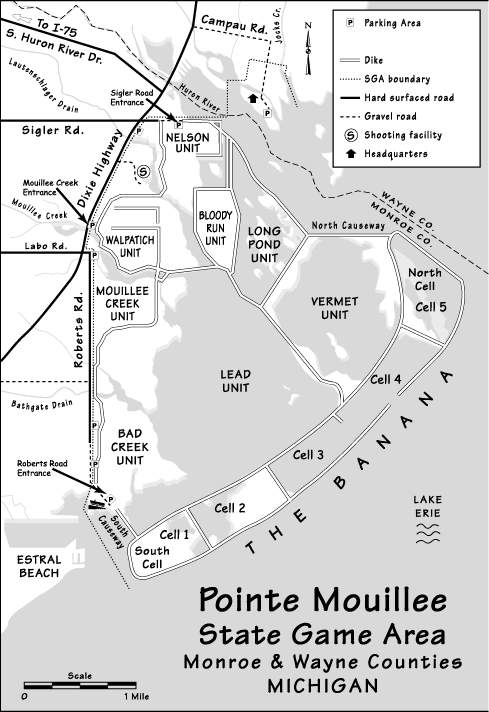
I had the map I printed off from the Point Mouillee DNR site, and kind of figured out how far we could go on “empty tanks” (i.e., bladders) and fully charged (i.e., MacDonald’s breakfast). We parked at the Sigler Rd. lot and ventured forth. Fortunately we also carried lots of water. By the way, the lack of restrooms there soon becomes moot as dehydration sets in on a hot day! Don't "sweat it" (as in worry about it) - because you actually will (in the physical sense)!

We learned from experienced people we met along the way (a couple of trip leaders- Jim Fowler and Mike McCullough who were scouting the place for a trip the following day) that the places where people were seeing and reporting birds (the best spots were on "The Banana" and on the Vermet Unit) were about 3.5 miles away - one way – from the Sigler parking lot.  Right!

A returning birder confirmed this. “It is by the trees over there”!


We had planned to make it to the closest corner of the Vermet Unit from where we parked (it sounded from the listserv that Vermet was the place!), but enroute learned that we would have needed scopes even if we had been on the best side of Vermet. We had binocs and cams, but chose not to carry the heavy scope and tripod. We turned around after reaching the near edge of Vermet (our goal - about a mile and half one way). It was a great temptation to continue, but knowing that we were not even close, and remembering that we had to return from wherever we walked, we turned around. We followed our plan. We shot lots of pics enroute. We had a great day anyway and the memories I share here.!

We made it to Vermet Unit!
(I think the trees in the distance are the cottonwoods that have filled in Cell 1 of the Banana Unit.)

I had been reading about “cell 3” on the birder's listserv. I used the Michigan DNR map and assumed it was the the "3" of the Long Pond Unit – hey, that’s the only "3" thing on the DNR map! We met another birder with binocs, a scope and tripod – much lighter than ours we had left in the trunk – who basically was frustrated. He had made the same mistake and walked even farther and was returning, yet had not walked to the “promised land”. Actually as it turned out, we had our best shots in the DNR Zone 3 (Zone - not Cell!) of the Long Pond Unit - three species of shorebirds (including the "lifer" Willet)  and our best pics ever of Pied-billed Grebes, so the "3 thing" was not too far off! (I think if we had gone a week later, we might have seen the King Rail there!). It’s a muddy canal right next to the dike and birds were up close and personal and basically unafraid! It doesn't look like much, but it worked out fine!

Our Best Site - Canal at Long Pond Unit Zone 3

Killdeer and Pied-billed Grebe

I had not done all my homework by checking out Bruce Bowman's site (I always keep making the same mistakes! If I would just go to Bruce’s site first rather than searching on my own, I would be far better off!) Bruce’s site offers 4 maps. One is the DNR map I had - it is really directed towards hunters. The best map shows actual mileages between multiple intermediate spots on the dikes (a copy of this was given us on the dikes by one of the trip leaders – Mike - who was scouting the place with Allen C. and Tom  on bikes). It is really useful for judging distance and endurance – you have to remember you gotta come back as well!. And I note the real "Cell 3" (actually part of The Banana) is a damn site closer to a parking lot – the south one off Roberts Road – than where we entered from Sigler Rd. We started from Roberts Rd. on a subsequent wonderful trip the next time (blog in process...) and. yes, it is much more reasonable!

On the way, we met Allen Chartier and company returning on bikes from their birding expedition that day. Judy took a few pics as always with her shorter lens setting (Thank you, my wonderful companion!!!).

Now, this is the way to do Pte.Mouille!!!


Note the openness and lack of shade! Point Mouillee just goes on "forever"! You can see the cottonwoods of Cell 1 in the distance over Mike's shoulder. I really like this pic because it shows how experienced birders approach a place like Pte. Mouillee! Sure beats walking!!!

L to R: "Dr. Bob", Tom Schlack, Allen Chartier, Mike McCullough

(I just have to wonder about the black box Tom was carrying. Was this "The Briefcase" or "The Football"  we hear about in the news sometimes? It sure looks impressive to me!)

It turns out that Allen was responsible for the best map posted on Bruce's site, and has it in his book. Yes, I know - always read Allen's book first before going to a new place! I keep re-learning this lesson as well. Read Allen's book and check out Bruce's site! Nuff said!

If you combine Bruce's map 1 and map 2, you get what is in Allen's book.

In a separate communication, Allen mentioned to me that the former "Lead Unit" in his Guide (and mostly used by birders) has been renamed the Humphries Unit. I understand it has something to do about how you pronounce "Lead Unit". You could pronounce it "leed" -  as in the first unit  - for which it was named  - or you could prounounce it as "led"  - possibly mistaken for the old shot pellets birds sometimes ingest - not so PC now! (Thanks, Allen for explaining this to me! It makes sense.)

From my research, I know that in the past there were some car break-ins at the southern parking lot, but when we left at about 12:30 pm today, we were the only car at Sigler Rd. and when we drove to the southern lot closer to the action there were six cars there. We were told that it is being monitored more now.  Note: on subsequent visits, we did see the lot being checked several times each day! Good stuff!

It was a great day for us. We did not record lots of interesting lifers as anticipated, but we shot some great pics and got a great story to tell.


Lesser and Greater Yellowlegs (verified)

I have never seen them together before. Yes, one is greater than the other.  I shot both species together! Really cool!


Willet! - "Lifer" (verified)


It looks rather non-descript on the mud, but lacks the yellow legs (even I can figure that out!). Yet, it does not have the drab gray breast of the willets in some bird books.

I think it is interesting that I am calling this a "lifer". I saw tons of Willets (and Avocets and lots of other goodies very rare in Michigan - ah, those were the days!) on the mudflats around San Francisco in my "former life", but I was not a "birder" then. I had taken a course in vertebrate biology and was a "bird watcher" in the sense I always carried binocs and a copy of Peterson in my vehicle when I went fishing or collecting seaweeds. I did record observations in my field books, but I cannot find the silly books now. I think I gave them to one university or another when I donated my collections. So, unless I find my old field notes, I am just choosing to start again. Oh, the stories they (the books) would tell!

On the other hand, it's cool to start again - I'm back to my teens and early twenties! Ah youth! It is really about almost as exciting as I remember it - well, at least from the birding perspective. Actually, from the birding perspective, it is even better than what I remember. Bird watchers were a rather strange sort and not as macho as I chose to represent myself then. Now birding has "come out of the closet" and represents a huge economic and social force! It's "in" and contagious! Besides that , I think it is now a great "chick magnet" for guys! Anyone who is knowledgeable in any outdoor pursuit just naturally seems to have a magnetic attraction. Hey, if women loved a guy like me who was mostly dedicated to walking beaches looking for seaweeds (oh my gosh, seaweeds!!!), once the "stigma" was removed,  I can see that a birder would be even more interesting!  Especially here in the Midwest lacking the natural appeal of ocean walks! Whew! 
 (Oh - did I digress? It happens ...)

Back to the story ...

Willet!


Willet!


What a difference flying makes! I am thankful for a few lucky pics! I well remember waiting for them to fly so I could be sure of what I saw around SF. Yes, I even guess sometimes the impatience of  my youth encouraged flight with a tossed stone. I sure wish I had owned a digital camera with "free film" back then!

Yellowlegs and Willet !


It is sure much easier to tell the difference when flying! And, that one is sure not a killdeer, dear!

(I make this reference remembering that just last year I had a Killdeer flying over Holland Ponds, and saw the striped wing pattern and asked for input on my terribly out-of-focus pic! "Killdeer", a few replied! OK , I got it! Judy and I now well know the Killdeer sounds! They are common and unmistakeable! We are using more of our senses now! Thanks guys!)

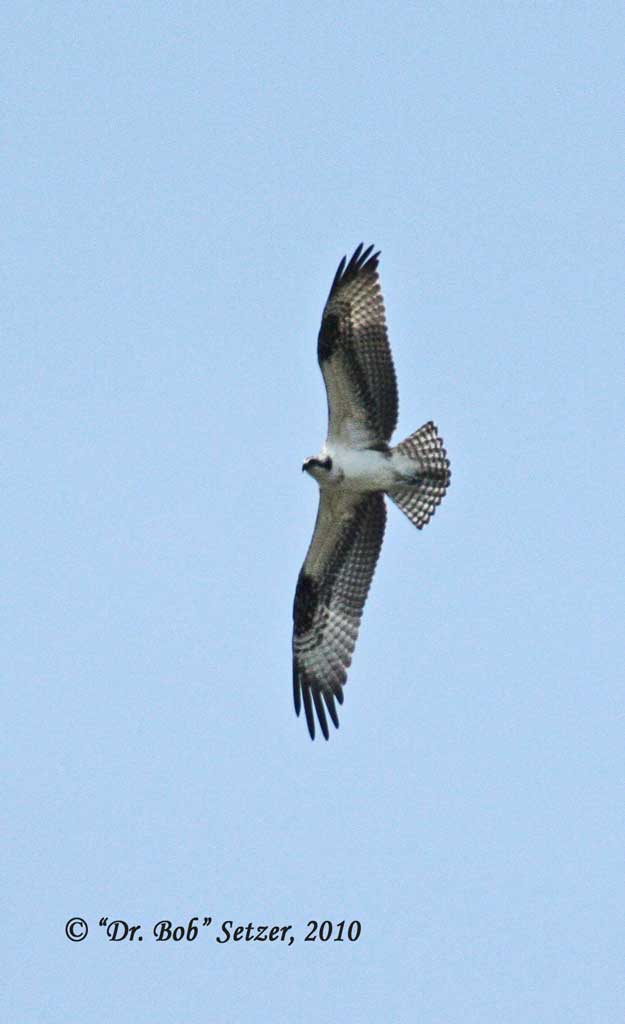
Osprey! (verified)


We thought ospreys were only around nesting sites like at Kensington, but this sure looked like the bird book pics. He circled many times, always coming closer. We waited. What luck! Wow! Incredible! I have quite a few pics of this bird who circled a few times. Geez! If I can ever shoot anything in the skies other than Turkey Vultures and the occasional Red-tailed Hawk, I am really fortunate! How special!!! This encounter alone was worth the walk!

Osprey!


Here are a few pics of a Greater Yellowlegs at Zone 3 of the Long Pond Unit. I like a couple because they show "bird camo" on the mudflats. Gray things on stick legs that look like plant stalks. I suspect an aerial view  - as seen by a predator - would be very informative.


I like these because they show an Oedipal personality of the birds (not that they really cared about looking at themselves...). Judy always likes a bit of anthropomorphism in bird pics. I think she just likes kissing in general ...


And, I just plain like this long-strider!


The following is the Buckeye Butterfly. It came north from Ohio in a large quantity this year. Even UM fans love and seek photos of this one. :) 

I love this pic where the "eyes" on the lower wing are hidden. I think it is an "anime happy face"! It is sure hard to shoot with its wings spread just right!!! We tried for a long time! Lucky!!! "Here's looking at you (i.e., me), kid"! You just gotta smile back!

Happy Face Butterfly!


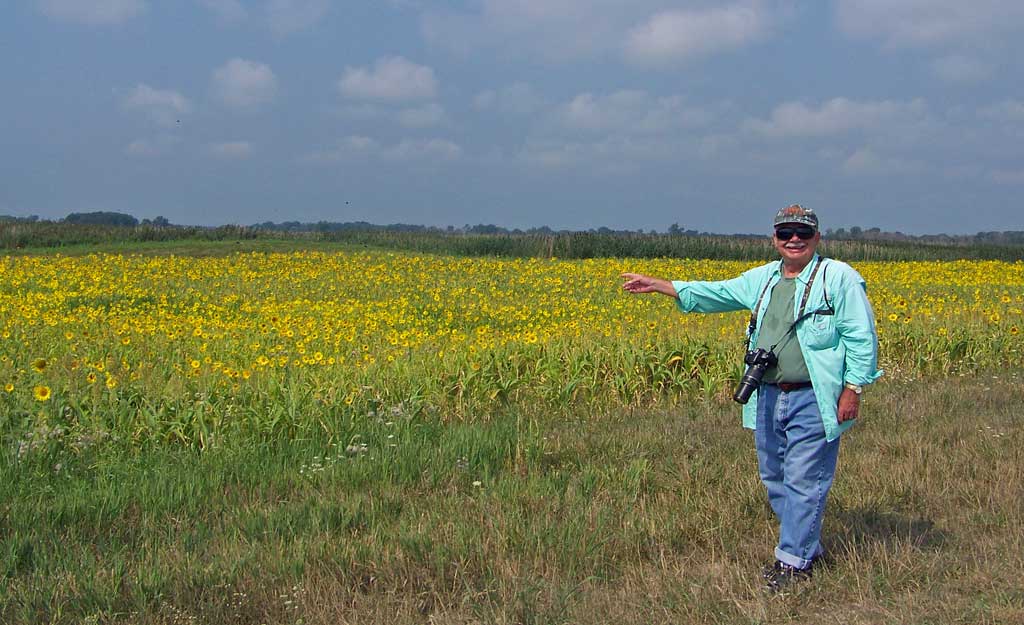
Another interesting thing along our walk was seeing a whole field of sunflowers. I guess we really did not notice them on the way out, but on the way back we noticed lots (really lots - dozens!) of Red-winged Blackbirds. Cool! Besides the pure natural beauty of the expanse, I think it is a great food source for the birds. I assume they were planted. Yes, maybe for a hunter audience, but certainly the majority of avian visitors will escape unharmed and better fed. Lovely!


After reaching the Vermet Unit and shooting pics of many American Coots, we headed back. As we were trudging along the Long Pond Unit (the long walk with little to see), we saw a vehicle approaching. Melted as we were by the heat, we stuck out our thumbs. It had been decades since I last hitched, but I am pleased to say it still works. I guess the border patrol agent could tell just by looking at us that we could really use a lift, so he invited us to ride in back. Another first - it was the first time (and hopefully the last) either of us had been in the cage in the back of an enforcement vehicle. Thank you so much for "capturing us"!!! I doubt our lives had been actually saved, but at that time it sure felt like it (gotta wonder), and it sure felt good to get back in the car and crank up the AC! Shortly thereafter, we were revived enough to discuss the memories of the day, and plan a better way to "do the Mou"!

We had learned many lessons about birding Pte. Mouillee. First, always "do your homework" (suggestions were provided above). Second, never set out mid-day on foot especially when the weather is so hot and muggy! And, third, if there are scheduled driving tours led by Audubon clubs (like there was the next day), jump on the possibility! Pte. Mouillee is a fantastic place, it is just huge in scale, and most of the good stuff now tends to be about a 5 mile round trip! If you do the whole round trip along the edges from Sigler and back along the roads, it's over 12 miles! (Now, there is a challenge for the really serious Hiking Michigan long hikers! I added this last note because I know Rob Golda usually links my blog on his HM site ...)

I hope you enjoyed this "ramble" and have a better idea of the challenge and joys of Pte. Mouillee!

"Dr. Bob"

Notes:

You saw that occasionally I noted "verified" on some pics. I did this to let you know that a reputable person agreed with me.

I can't believe I am really talking like I know something about Pte. Mouille! But, actually after three visits, and after having finally done my homework, I really do! It is a national treasure here in Michigan!

You will now have to wait until sometime after hunting season to go out there.  (I am not sure when it reopens for birders or hikers.)  Be sure to do your homework first! It is a wonderful challenge and a great opportunity to see birds and environments you may not see elsewhere! I do not know about spring, but obviously it is a significant stop-over for migrating fall shorebirds! "What a trip"!!!

Friday, August 13, 2010

Newbie on eBird - some thoughts

I am writing this blog to express my enthusiasm for eBird.

I am finally using a tool to record my bird data! I have a couple of years of checklists (i.e., 3x5 cards in the field) and notes in my journal, but I had nothing to pull them together. I started a spreadsheet with Michigan birds I downloaded from Bruce Bowman's excellent site, but it soon overwhelmed me. It had all the birds in Michigan in the spreadsheet! I thought about deleting the ones I might never see, but then thought I needed to be reminded of them as possible choices. With my life list approaching only 75 birds, you can see why it was a dilemma!!

eBird makes it easy! (like really easy!). You enter your collecting place and minimal trip data (like time and distance - or just location and sightings if you just observed in one place), and then it gives you a list of suspected birds there. eBird already has knowledge (built up by verified records) about the suspected birds in a county or a HotSpot!

It is so quick, you will want to enter your data the same day after you get home. If your memory is fairly decent, you will probably remember all the birds you just saw without even having the 3x5 cards. Entered! Done!

I hate typing! eBird makes it easy to record bird species by just "x-ing" a box or putting the number of birds seen. Then you can export your bird list into something else, or send the list to yourself in an e-mail to forward to your friends. Cool!

When you submit your data, you first enter the location. eBird provides a great mapping tool so you can exactly pinpoint your location on a satellite map. If you are not familiar with the web's wonderful satellite mapping capability, this is enough of a reason to check it out! The checklist eBird provides only contains the expected birds for that geographic area. That sure helped me out! It also allows you to add other birds, but for me it really helps to cut down of the number of species in (for example) the eastern bird books or a Michigan list.

For example, here is a pic of Holland Ponds:


Another unexpected advantage is that as I scroll through the list to check off my birds, I am learning about bird groups! Hey, the bird books now make more sense in their phylogenetic arrangement. Besides learning related groups, this will help me to better flip to a group in the books without going to the index. (Yes, eBird would also allow me to go directly to a species to enter my data, but that would spoil my new-found learning tool!)

I imported a list of birds from an Excel spreadsheet into this blog. I had first recorded them in eBird, then downloaded them into an Excel spreadsheet on my own computer. The download was quick (a click). The importing here was quick (select spreadsheet cells, copy - then paste here). The paste did insert a couple of carriage returns between the lines, but it was quite easy to delete them. The following is a Holland Ponds list I imported from eBird. (I blogged about that day in another post.) It does not include minks, butterflies, and the like, but it is a great start. In the future, I will add my birds into eBird, then import into Blogspot. No typing twice!!! And, I have now figured out how to comment in the Notes section to include the other great things we see on a trip.

Canada Goose
Mallard
Great Blue Heron
Mourning Dove
Belted Kingfisher
Eastern Kingbird
Tree Swallow
Blue-gray Gnatcatcher
Eastern Bluebird
American Robin
Gray Catbird
Northern Cardinal
Red-winged Blackbird
Baltimore Oriole
American Goldfinch
House Sparrow

Or you can ask eBird to just e-mail you the results of your reporting. That way you will have an individual record (but you really do not need one - eBird will keep it for you!). Anyway, you can copy/paste from the e-Mail and add it to a blog or whatever. Here is exactly what you get (a different example - again I had to take out  a few extraneous carriage returns). You can add number of birds, comments on individual species, and even a comment for the whole trip on eBird. You can see the results here. (I am getting better, so my recent lists actually have numbers of birds, and not just "X"s, but you can see that either way works! An "X" puts the bird into your life list and your state and county lists anyway.)

Location: Holland Ponds
Observation date: 4/22/10
Notes: Also little blue butterfly and medium white butterfly
Number of species: 12
Mallard 5
Great Blue Heron X
Downy Woodpecker X
Northern Flicker X
Tree Swallow X
Black-capped Chickadee X Some at the nest boxes
American Robin X
Northern Cardinal X
Red-winged Blackbird X
Common Grackle X
Brown-headed Cowbird X
American Goldfinch X

Pretty cool, huh?!

eBird is a powerful tool. People have been encouraging me to use it for some time, but I procrastinated until Ed Lewandowski "shared" a list with me from a day we birded together recently. "Sharing" is a powerful tool whereby a designated recorder on a group trip can record the species seen and "share" with everyone on the trip. After you accept the shared list, it adds the species for the day to your eBird lists. You have the option as an individual to subtract species you did not see (I do this a lot!) or add species you saw that the recorder did not (I can only dream!). You can also add your own comments about specific birds in your individual eBird space, as well as your personal trip notes. (This I can do...)

By using eBird, you are making your data available to Cornell University and the whole birding community. You can actually be making a difference to the scientific study of bird distributions. In the long run, this is really the most powerful contribution you can make! YOUR data will help everyone better understand distributions of our feathered friends!

Even more fun and personally useful is that eBird will keep your "life list". You can find out all of the birds you have seen in all of your trips. It also tells you specifically what birds you saw where and when.

You can "slice and dice" the data in a variety of ways. You can see what species have been recorded for a particular location, or region, or state. You can see who the main listing birders (no, not the birders who are tilting, the ones who put up lists on eBird) are in any area, and the number of species they have recorded for the area. This gives you some idea of your chances of how many birds you might see there (over time).

You can see the first and last reported dates for each species in the area. You can get to a map of the area for them.  You can see bar graph charts like in Allen Chartier's great Birder's Guide to Michigan book, but even for individual locations!

Since I started writing a draft of this note, I actually got Holland Ponds accepted as an eBird HotSpot in Macomb County. It is a well-deserved designation! Now anyone entering data for Holland Ponds can select the location from among the HotSpots. This allows data to be combined into a location list. Powerful! Imagine having data from all the birders who visit Holland Ponds at different times (and with very different levels of experience I might note) combined into a more complete avifauna! What a great thing for Shadbush Nature Center that administers Holland Ponds! (By the way, y'all, I encourage anyone with past Holland Ponds data to try to merge it into the newly designated HotSpot! Please! We love the place and want to see it protected!) Thank you to the Michigan HotSpot coordinator!!!

For "Birding Hotspots" you get a wealth of info. For example, I learned how to go to the birding hotspots already on eBird for Michigan. Robert H. Long Nature Park was one of our favorites last year - great place for Red-Headed Woodpeckers, local shorebirds at certain times, and just a great number of species on a regular day! The following URL will take you there. You will see all reported birds (first reports)  for 2010, you can get a great map - even a satellite pic of the area (hey, click around!). Ah, technology is wonderful! Try it by following this link: eBird RH Long

Hey! I am a newbie! I only list the birds in which I am confident of my observations (not too many, but growing). Imagine if all the experienced birders with years of experience took the time to report their observations! Wow! What a data base!

Imagine if all the "local birders" like me just reported the birds that hit their feeders (I record "my deck birds" daily and will start downloading my past lists soon onto eBird)!

One thing to think about when making your field notes is the county lines. For example, Kensington Metro Park and Stoney Creek Metro Park both straddle county lines. Part of the reporting power of eBird is that it can summarize by county - hence you need to know the correct county for your observations. Just check the map sometime, so you will remember the "imaginary" (What do birds care about county lines!) boundaries for your places next time.

Oh. Another really cool thing is that even after you submit your data, you can go back later and make changes. This takes some of the "fear" out of saying you saw something and later finding out you were wrong. For example, I often take photos and look at them much later. If I see that I made a mistaken ID in eBird, I can correct it. I can add the birds I did not know when I shot them. So - fear not!

I sense eBird is making me a better birder. Since they have a place for recording the sex and comments on individual species, I now look more closely. (No, you do not have to do this - it is an option if you want to record details or comments on birds...). Now - at least for my deck birds - I have to pull out the binocs to sex and age the birds when I can. I am forced deeper into the field guides! Was that a juvenile female Cardinal? I am forced to learn more! Instead of just "ticking off" a species, I am starting to "tick off" individuals within a species!

I also now try to count the birds I see. I always had my own scale - "one, a few, many, abundant, dominant". It turns out that this translates reasonably well for eBird. They want a number, but the number is as relative as my own scale. One bird means something - a sighting, a presence. Ten birds - I can count by twos to get this. Forty birds - maybe 35 to 45? A hundred birds is far different than 200 birds, and so on! I was always intimidated with counting birds. Damn things move before I could finish my count! (If I ever tried to count more than 10 birds at a time...). I am compulsive. I wanted precision. I would not "count" because of that! Forget that! Who cares if there were 176 birds or 212? It is the relative number that "counts"! 200 birds are far more than 10 or 100! I'll now "chunk off" maybe 20 birds and just move my binocs or eyes to use that "chunk" to count the birds! I have noticed on eBird that our best birders seem to do that! I often see counts of 100 or 200, but never 186 or 227! I now fear not - I am with the best "counters"!

Yes, I really enjoy eBird (as if you could not tell...).

I really want to express my appreciation to the Cornell University staff and volunteer network for making this great tool available and for being so quick in responses to the few questions I sent them!

eBird is "chinchy"! Try it! It really has made a big difference in how I "bird"!

- "Dr. Bob"

PS, I started this note back in June when I started using eBird. I am just now posting it. I am even more favorable about the site than I was then. I did want to write a longer story, but really, it speaks for itself, so just try it for yourself.